

Cleaning…. it’s something that we all do, everyday…or at least most days. In my Little Foot journey my next stop is our kitchen, specifically our cleaning products. I really want to move away from using harmful and toxic chemicals in my home, and I really want to avoid washing them down our sink and into our oceans. So, as promised, here is what I have come up with so far. As always, this is not something that I have decided to do overnight. I have collected the ingredients, I have used up the off-the-shelf products so I am not wasting anything (I kept their containers to reuse them), over some time.
Now I know that the internet is full of recipes and ideas around this so, let’s face it, we are spoiled for choice. I’m going to share the ingredients I am using, the recipes I am trying, and how I am finding it.
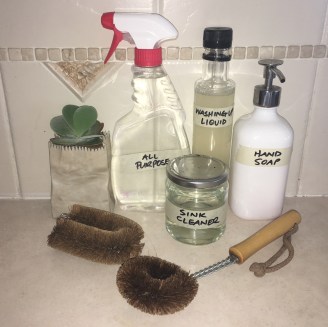
First: All-purpose cleaning solution. I use this on counter tops and for quick clean ups. The recipe calls for 250ml vinegar, 2 teaspoons borax, ½ teaspoon castile soap, 500ml hot water. Put all ingredients into your container and shake well until the borax dissolves. You can store and use this indefinitely. To make your spray antibacterial, add 10-12 drops of lavender or tea tree pure essential oil. So far I have found this to be great. It cleans, and it smells super natural without the crazy remaining chemical smell.
Second: Washing-up liquid.I adjusted the recipe for this to fit the container I had; a recycled olive oil bottle. The recipe includes 175ml castile soap, 120ml water, 5-10 drops of lavender or rosemary pure essential oil. The weird thing about this liquid, in comparison to store-bought liquid, is that it does not froth and bubble up in the same way. I took a snap to show you. This did not make any difference to the cleaning capability of this liquid. I was pleasantly surprised actually that the glasses and dishes cleaned up just as well. For me this shows that chemicals and toxins are not needed for a good clean.


Third: Stainless Steel sink cleaner. The kitchen sink is one of the more neglected areas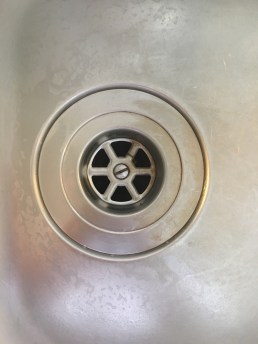 in our cleaning routine. Combine 50g bicarbonate soda with 1lt of warm water until dissolved. Wash the sink with the solution and a soft cloth, using a recycled toothbrush for rims, then rinse and wipe dry with a soft cloth. I actually couldn’t believe how clean and shiny my sink came up using this solution. I took a snap of my sink, half cleaned, so you can see how well this works.
Lastly: Natural cleaning tools. I made a point of swapping out my plastic cleaning tools to natural non-toxic cleaning tools that are better for the environment. For cloths, I use old cotton towels cut to size. I ran a zig-zag stitch around the cut edges to avoid fraying. I got 8 cloths out of 1 old hand towel, so I always have plenty of wipes, and I just wash them as often as I need to. In the sink, I use the Eco Max Dish Brush and Kitchen Scrubber from Flora & Fauna https://www.floraandfauna.com.au/household/?pgnum=1
I’ve discussed Arbonne’s Pure Essential Oils from their Rescue and Renew range. I used the Lavender and the Tea Tree oils in my recipes for their antibacterial qualities. They’re sustainably sourced and extracted using steam distillation or cold pressing techniques.


One of the simplest ways to have a big impact on the health of your home, your family, and the environment is to ‘green’ your cleaning. It doesn’t cost more or take more time, but it does require a shift on how we define ‘clean’. Clean means clear of dirt and germs, and how the surface and objects in your home look. A clean green home is still one that is free of dirt and germs, but also one that is free of toxic pollution. When you finish green cleaning a room, the air should be as clean or cleaner than when you started. Using products that pollute the air in not cleaning, its polluting.

 Little Foot